NER Travel Order
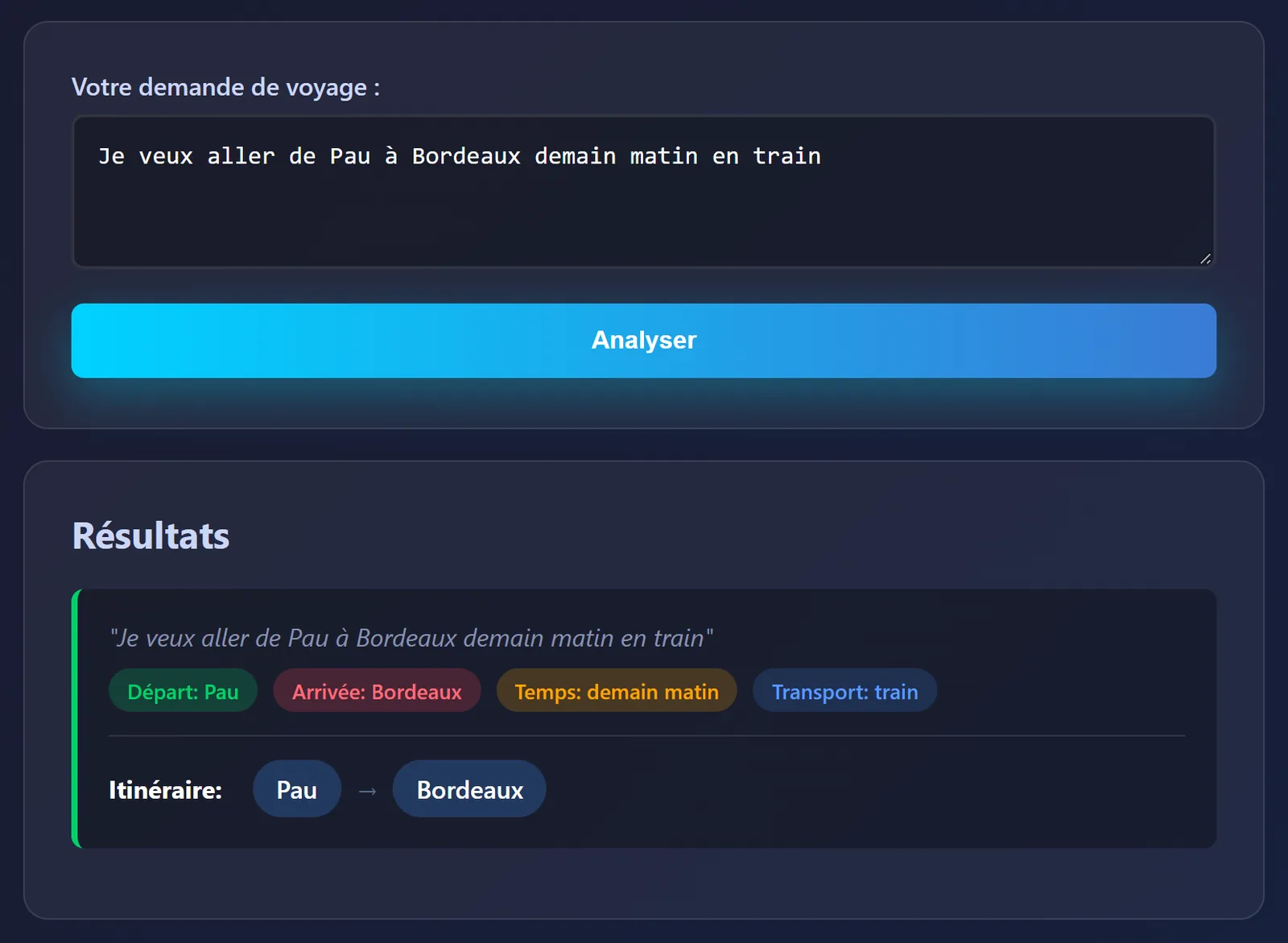
French entity extraction system using CamemBERT fine-tuning
12,000annotated sentences
17×lighter than CamemBERT
~10 msper sentence on CPU (measured)
Problem
Travel order processing required manual extraction of key entities (departure location, arrival location, dates, transportation type) from unstructured French text. This was time-consuming, error-prone, and didn't scale for batch processing.
Solution
Trained and compared two NER models on a French corpus with BIO tagging, then shipped the one that made sense in production:
- Fine-tuned CamemBERT on a 12,000-sentence annotated French corpus
- Two models, benchmarked head to head: a custom spaCy v3 pipeline (~10 ms per sentence measured on CPU, 26 MB) against a fine-tuned CamemBERT (440 MB), which is better on ambiguous sentences on the same corpus
- spaCy chosen for production: 5 F1 points traded for a 10× latency reduction and a 29× smaller model, the right call for CPU-only serving
- Token classification with BIO tagging (Begin, Inside, Outside) for 6 entity types: DEP, ARR, TEMP, TRANSPORT, PER, MISC
- Evaluation-first approach: entity-level F1, precision, recall metrics (not token-level)
- Production pipeline: inference optimized for batch and real-time processing
- Bilingual support: French text input with structured JSON output
Results & Metrics
12,000
Training sentences
6
Entity Types
spaCy
chosen for production
~10 ms
Measured spaCy latency (CPU)
70/15/15
Train/Val/Test Split
Technology Stack
 CamemBERT
Hugging Face
 PyTorch
 spaCy
 Python
seqeval
 JSON
 Flask
Key Learnings
- French NLP matters: CamemBERT outperforms multilingual models on French-specific text
- Entity-level evaluation is crucial: Token-level accuracy hides extraction failures; entity F1 is the real metric
- Annotation quality drives performance: Small, high-quality dataset beats large, noisy one
- BIO tagging disambiguation: Careful label scheme design prevents entity boundary errors
- Production readiness: Inference optimization + versioning + monitoring separate research from deployment